






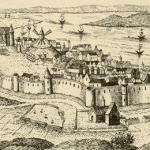




A while ago I went to Saint Valery sur Somme, a small port city, with my family. The instigator to this trip told us that this town was quite famous –and pretty. Why was it famous, though, I had to find that out!
Before being called Saint-Valéry-sur-Somme, the city was, it seems, called Leucone or Leuconaus (a Greek word that means mountain or cliff) and was only an islet during high tides. Occupied by romans until the end of the 5th century, Greeks supposedly lived here but no archeological dig could prove this.
In 611, Leucone’s lands were given by King Clotaire II to Monk Gualaric (who was also named Walric, Waleric then Valery) who was sent there to evangelize the region.
Monk Valery, who came from the Auvergne region, had been intensely interested by religion since very young and traveled from one monastery to the next during his search for a strict and austere discipline. He found it in Luxeuil where he became a disciple of the future Saint Colomban. As Colomban had to go on exile for a while, Monk Valery had to take care of the monastery then was sent to evangelize the region of Leucone when Colomban came back.
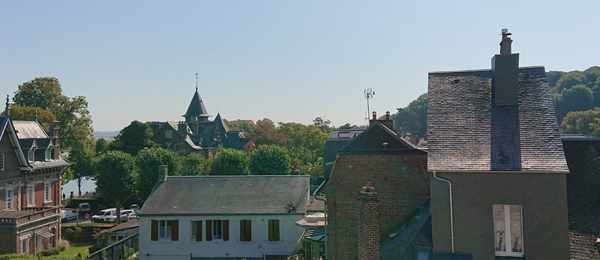
Monk Valery settled on Leucone’s higher grounds. His virtue and miracles brought to him many disciples, including Saint Bilmont – miraculously healed by Saint Valery, which then became the basis of the primitive abbey. Saint-Valery-sur-Somme town started developing thanks to, among other things, the construction of the Saint-Valery abbey around 627. The relics of the saint attracted many pilgrims to the city but were pillaged by Vikings between the 8th and 9th centry. The abbey was demolished and reconstructed many times but only ruins remains now.
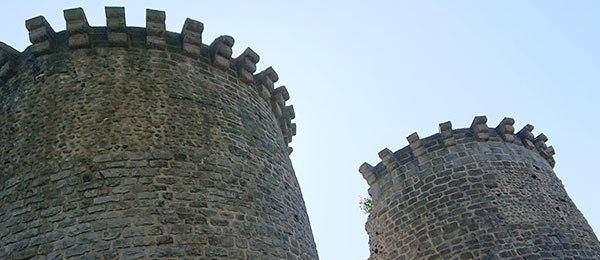
In 1430, Joan of Arc, prisoner of the British, went through the town as she was being escorted to Rouen where she would get burned. During this time, the British demolished parts of the town’s walls and used the stones to reinforce the castle. While strolling around Saint-Valery-sur-Somme, you can find the “Joan of Arc’s gates” of the town which the went through on the 20th of December.
During the religious wars, in June 1568, Captain Cocqueville, a Huguenot1, took over the city. He was defeated the 18th of July by Cossé-Brissac, the Governor of Picardy. The Marchal of Cossé took back the town and slaughtered all of the Protestants that were residing inside.
Filled with a lot of stories of the past, of wars and of destruction, Saint-Valery-sur-Somme was a little more saved from the bombings and attacks during the first and second World Wars. During the World Ward One, the town was a refuge for the French and Belgians, and a supply port for the British allies. However, during World War Two, two young people of Saint-Valery, aged 18 and 21 years old, were shot in the ditches of the citadel of Amiens as they were accused to be “francs-tireurs” (French resistance) by the German.
1 Huguenots (/ˈhjuːɡənɒts/) were a religious group of protestants from France and Navarre (a part of Spain) during the religious wars until the second half of the 16th century.



Recent Comments