





Do you know about Nihonbashi? It is located between the districts of Ginza and Akihabara. Almost everyone goes through Nihonbashi at least once during a trip in Tokyo but few are those who know about it.
This district has actually the same name as its bridge. In fact, Nihonbashi means “bridge of Japan” in Japanese. It is said that Tokugawa Ieyasu, who was the first shogun of Japan, asked for this bridge to be build in 1603, the beginning year of the Edo period. This bridge also hold Japan’s zero kilometer marks as, the year after being build, it became the starting point of the 5 major roads of Japan called the Gokaidô (五街道). Two went up to the North towards Nikko while the other three went to the South towards Kyoto. These roads linked many countryside villages to Edo, going through Nihonbashi, making this district the central point of Japan. Even nowadays, Nihonbashi’s bridge is the starting points of many highways of Japan. But that is not all…
Have you already heard of Tsukiji fish market –relocated nowadays to Toyosu? I think you did, however you might not know about the Uogashi fish market. In fact, Uogashi was the ancestor of Tsukiji fish market and was located around Nihonbashi’s bridge which made Nihonbashi a thriving merchant district in which lots of money circulated. Attracted by such a lively market, many other activities bloomed around it and one could find Kabuki theaters, Bunraku puppet theaters and even Geishas’ performances! Nowadays, people can still come see Geishas’ performances and anyone can go to them –and even participate in some of them- on the condition of reserving in advance.
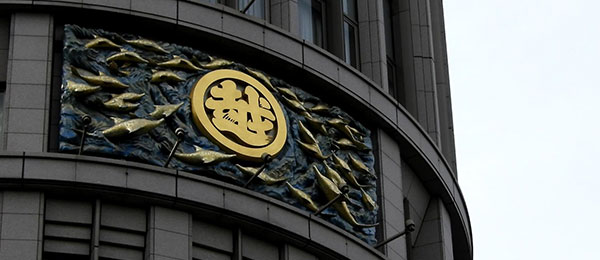
Nihonbashi’s distric had many tragical incidents, which includes the Bunka great fire in 1806 that burned down a great part of the distric. Only a few buildings from that time are still standing such as the Sumitomo Mitsui Trust Bank and that of the Bank of Japan, which are the oldest you can find while strolling around in Nihonbashi. They were built respectively in 1929 and 1892. While touring inside the district if you observe Mitsui Bank’s building –as well as Mitsukoshi department store’s, you will see that they don’t go higher than other newer buildings which are around them: That is because, until 1963, the buildings in Japan had a limitation to their highness. Due to aesthetic and technical concerns (partly due to the risk of collapse during earthquakes), buildings were limited to a 100 shaku height (correspond to approximately 100 feets or 31 meters). To preserve this vision of past times, the newest buildings were made so that we could only see until this height limit while standing under them.
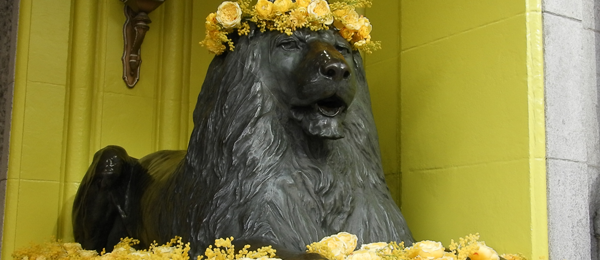
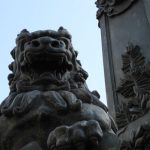
Strolling on the main road of Nihonbashi, Chuo-dori, you might certainly see Mitsukoshi’s entrance, guarded by two big bronze lions, which are the replicas of London’s Trafalga Square lions. They guard the entrance of Mitsukoshi since 1914 and were ordered by the previous manager, Ousube Hibi. There lions, however, are more known for their story during World War Two when they were confiscated by the Japanese army in 1941. Everyone thought those two lions were melted to make weaponry for the army but they appeared to be wrong. They were found in Harajuku’s Togo temple in 1946 and were then moved back to Nihonbashi to continue guarding Mitsukoshi’s entrance. They symbolize luck and it is said that if you can get on the back of one of them without being seen, luck will always follow you. However people prefer to just rub the lions’ paws in hope to get a tiny bit of luck instead of trying to do the impossible as the streets are always full of people.
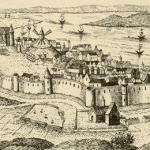
As for Nihonbashi’s old landmarks, most of them are not here anymore or have greatly changed like the Nihonbashi bridge, made out of wood in 1603, which is currently at its 11th version made of stones. A street in Nihonbashi is also made of stones from the same quarry as the bridge, you can discover it between COREDO 2 and 3. Although many of the old buildings have disappeared, some stores that have been in Nihonbashi since long ago are still in service today. A painting made on a scroll in 1805, the Kidai Shoran, shows us how was Chuo-dori a year before the great Bunka fire. This scroll was found in 1955 by a teacher of the University of Berlin, Mr Hans Joachim Kuster, in the cellar of one of his relatives. He gave it to the Museum of Asian Arts of Berlin but we can find an enlarged copy of it in Nihonbashi’s Mitsukoshi-mae subway station.
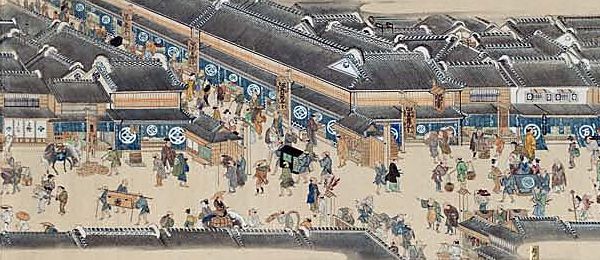
Observing the stores’ fronts, we can see thanks to the noren (Japanese curtain used to promote an establishment) two brands still in service in Nihonbashi: Mitsukoshi department store (written 三越, noren shows 三) and a famous cutler called Kiya (written 木屋, noren shows 木). A the time, Mitsukoshi was a chain of stores specializing in kimono and Kiya were stores that specialized in different types of arts. However, all Kiya stores sold off all of their products, and was left only the cutler as a Kiya shop. They are now known as one of the best of Japan.
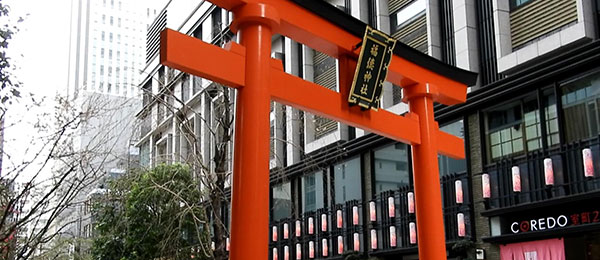
Many historical figures visited the district and its temple. Right next to COREDO Muromachi mall, you can find the Fukutoku shrine, dedicated to the harvest and business god Inari. It is a shrine that was recently rebuild and restored. In 1590, not long before becoming shogun, Tokugaya Ieyasu came to the shrine and felt so strongly connected to it that it is said his soul is now residing inside the shrine. A few years later, his son, Tokugawa Hidetada, came to the shrine and saw a sprout coming out of the torii gate which, at the time, was made of wood still with bark. Seeing this sprout, he gave to the shrine the nickname of Mebuki (芽吹き, sprout) and even nowadays this nickname has a very special place in the temple: all of the green color you will see in and around the shrine refer to this sprout.
What to do or see in Nihonbashi:
At the information center in the basement of COREDO Muromachi 1:
– Guided tour of the old shops of the district (includes free tasting for the Gourmet tour, reserve in advance).
– Origami folding or Hanko (japanese stamp) designing activities
– Procure yourself a map of Nihonbashi
In Mitsukoshi-mae station
– Two times per year, an used kimono market open for some weeks between COREDO Muromachi 1 and 3
– Kidai Shoran’s scroll replica
In Nihonbashi
– Go see or pray at Fukutoku Shrine
– Try some castella cakes at Bunmeido
– Take a look at some traditionnal washi papers at Yubendo (small shop near COREDO Muromachi) and Ozu Washi (they also have a Washi paper museum)
– Try the coffee cakes at Mikado Coffee
– Look around inside Mitsukoshi department store
– Buy a kimono in COREDO Nihonbashi (washable kimono can be found at around 50$ during sales)
– Take a look inside Takashimaya department store
– Buy real Japanese green tea at Yamamotoyama
– Take a look inside Maruzen shop which hold a large variety of stationeries

Recent Comments